Nobody scrolls Instagram searching for a roofer. Meta Ads work differently from Google, they interrupt the right homeowner with the right signal, home value, homeownership status, engagement with home-improvement content, before they've started looking. We rebuilt one roofing contractor's Meta account around Conversions API tracking, audience layering, and a real retargeting funnel: 572 qualified leads at $11.67 cost per lead in 31 days, a 4× increase in lead volume at the same ad spend as their previous agency.
Home Service Lead Generation Agency, 4.8 Verified Rating
Trusted by contractors in Texas, Arizona, California, Florida, and 20+ states
Google Ads meets a homeowner who's already searching. Meta Ads have to earn attention from someone scrolling past vacation photos who wasn't thinking about their roof five seconds ago. That's not a worse channel, it's a different mechanism, and treating a Meta account like a Google account is the single most common reason contractors say “we tried Facebook ads once, never again.”
There's no “roof repair” search to target. Instead, campaigns target homeowner status, home value, age, and engagement with home-improvement content, layered with lookalike audiences built from your best existing customers.
Apple's privacy changes mean Meta's browser pixel alone misses a real share of conversions. Without server-side Conversions API tracking, the algorithm optimizes toward incomplete data, and campaigns look worse than they actually are.
The same audience sees your ad repeatedly on Facebook and Instagram in a way Google Search users don't. Click-through rate declines as creative fatigues, quietly raising cost per lead even when nothing else in the account changed.
Cold interest/lookalike audiences build awareness, warm retargeting re-engages website visitors, and hot CRM-list audiences close the loop. Running one flat audience with no layering is the most common way budget gets wasted.
Most Meta accounts run one campaign type and stop. An account built to book jobs, not just collect form-fills, layers all three, feeding data from each one back into the others.
Instant forms that never leave Facebook or Instagram. Lowest friction, highest volume, but lower average intent since a homeowner never has to visit your site or see proof of your work before submitting.
Best for: building initial audience volume and CRM list size fast, especially in a new account with no retargeting data yet.
Ads that send clicks to a dedicated landing page instead of an on-platform form. Slightly more friction, but the homeowner sees proof, reviews, and your actual offer before converting, and every click can be pixel- and CAPI-tracked for retargeting.
Best for: higher-ticket services (roof replacement, solar, remodeling) where trust-building before the ask matters.
Re-engages website visitors, video viewers, and uploaded CRM lead lists, plus lookalike audiences built from your best customers. This layer typically produces the lowest cost per lead in the account, because it's reaching people who already showed interest.
Best for: every account, once there's 30+ days of pixel/CAPI data to build audiences from.
Google accounts are structured by service line. Meta accounts are structured by audience temperature, cold, warm, and hot, because that's what determines which creative, offer, and bid strategy actually converts.
Cold (interest & lookalike), warm (website retargeting), and hot (CRM custom audiences) each get their own campaign with its own budget and bid strategy, instead of one campaign trying to serve every stage of interest at once.
Server-side conversion tracking is configured before a dollar of spend goes live, recovering the attribution data iOS 14.5 privacy changes strip from browser-pixel-only tracking. Without this, the algorithm is optimizing half-blind.
Multiple angles, testimonial, before/after, offer-led, tested against each other and refreshed every 2-3 weeks before fatigue sets in. A single ad running for months is the fastest way to watch cost per lead climb for no visible reason.
A 1% lookalike of booked jobs (not just form-fills) targets homeowners who resemble people who actually became paying customers, not just people who resembled someone curious enough to fill out a form.
Every lead is tagged by campaign, ad set, and creative in the CRM, so weekly reporting can show which specific audience and creative combination is actually producing booked jobs, not just cheap form-fills.
Almost every “Meta ads don't work for us” story traces back to one of these five, and each is fixable without starting over.
On-platform forms are fast to launch, but without ever sending traffic to a landing page, the account never builds a website-visitor retargeting pool, the single highest-ROAS audience Meta can produce.
Fix: run landing page traffic alongside lead forms from month one, even at a smaller budget split.Browser-pixel-only tracking loses a meaningful share of conversions post-iOS 14.5. Without server-side tracking, Meta's algorithm optimizes toward incomplete data, and reported cost per lead looks worse than reality, or better, in ways that mislead budget decisions either way.
Fix: Conversions API wired server-side before any meaningful spend goes live.Facebook and Instagram audiences see an ad repeatedly in a way Search users don't. Click-through rate quietly declines as creative fatigues, and cost per lead climbs even though nothing else in the account changed.
Fix: 3-4 creative variants per ad set, refreshed every 2-3 weeks.A flat “homeowners, age 30-65” audience wastes spend on renters, apartment dwellers who happen to fit the age range, and homeowners who could never afford the job. Home value and life-stage signals matter as much as homeownership status itself.
Fix: layer home value, homeownership status, and life-stage signals, not just age and location.Meta leads decay in minutes, not hours, faster than most other channels because the homeowner wasn't actively looking when they converted, and their attention moves on fast. A missed-call text-back and instant CRM follow-up recovered 30% of leads that would otherwise have gone cold on our own client work.
Fix: instant CRM entry and automated first-touch follow-up within minutes of form submission.Local SEO and Google Ads capture demand that already exists. Meta Ads builds and retargets demand that doesn't know it's looking yet, feeding the same landing pages, the same CRM, and the same calendar as every other stage.
Local SEO and Google Ads capture homeowners who are already looking. Meta Ads extend reach to homeowners who aren't searching yet, and retarget the ones who visited your site from another channel but didn't convert. Running Meta before the first two are solid usually just adds cost without a foundation to retarget against.
A Meta click or form-fill enters the CRM instantly (Stage 4), our appointment setters follow up within minutes (Stage 5), and every lead is traced back to the exact ad set and creative that produced it, so budget can move toward what's actually filling the calendar.
Not form-fills, not click-through rate. Every Meta audience segment is tracked through to a booked appointment. A cheap lead that never books is worse than an expensive one that does, and weekly reporting shows the difference.
A roofing contractor was paying $47 per lead to a generic agency running Meta campaigns with no home service experience, and the leads that came in were cold by the time anyone called back. We rebuilt the account around audience layering, Conversions API tracking, and a missed-call text-back system, producing 572 leads at $11.67 CPL, a 4× increase in volume at the same total spend. The cost-per-booked-job figure is still being finalized with the client, this case study is about lead quality and volume, not just a low CPL.
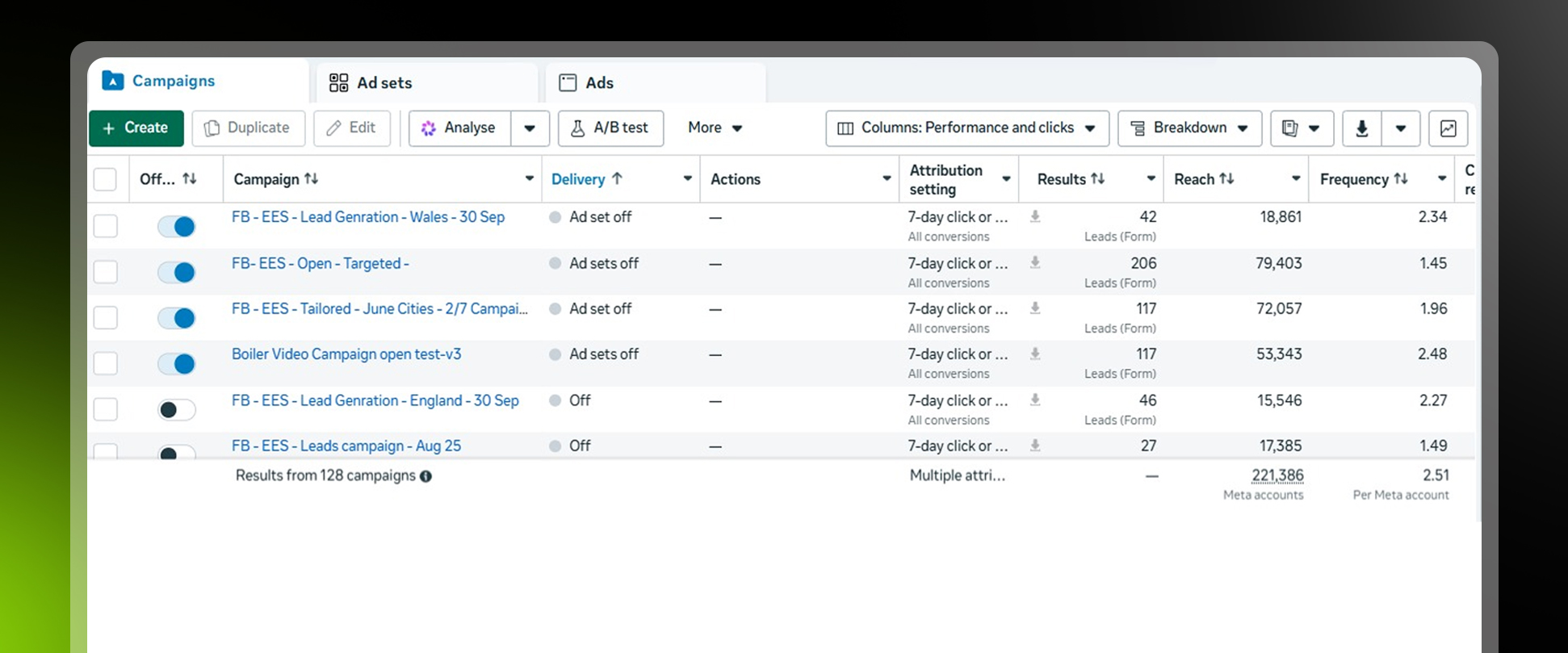
If you're already running Meta Ads, we review your existing account before recommending anything. If you're starting from zero, we map out exactly how your account should be structured before you spend a dollar.
Audience layering review, whether your account has cold, warm, and hot audiences, or one flat audience trying to do everything.
Conversions API & pixel health check, whether your account is tracking conversions accurately post-iOS 14.5, or optimizing toward incomplete data.
Creative fatigue audit, how long your current ads have been running, and whether declining performance traces back to audience burnout.
Audience overlap check, whether your ad sets are competing against each other for the same homeowners and inflating your own costs.
Retargeting funnel audit, whether website visitors and CRM leads are actually being re-engaged, or disappearing after the first touch.
20 minutes. We'll review your current account (or your market, if you're starting fresh) and tell you honestly what's working, what's wasting budget, and what a properly structured account would cost to run.
Book Free Audit & Consultation →No contracts required. We tell you honestly whether Meta Ads makes sense for your market before you commit any budget.
Honest answers, the same ones we give on a discovery call.
Same platform, different playbook. Roofing runs on storm-response retargeting. HVAC splits by season and job type. Solar needs an educational funnel for a 2–6 week decision. Plumbing uses Meta for brand-building, not emergency capture. Remodeling sells on a before/after portfolio.
Real results by trade: 1,190+ HVAC leads from Google & Meta combined · SunPower Home Solutions, 250% more solar appointments
The exact audit we run before taking on a new client — see where your site is leaking booked jobs.
Book your free Meta Ads account audit. We'll show you exactly where your budget is going, what a properly structured account would look like, and what it would take to get there.