The instinct when the calendar's empty is to blame lead quality. It's almost never the leads. We analyzed 3,000+ contractor leads and traced 47% of missed jobs to a single fixable cause: no one responded within 10 minutes. The homeowner had already moved on. Here's where the other 53% go — and exactly what closes each gap.
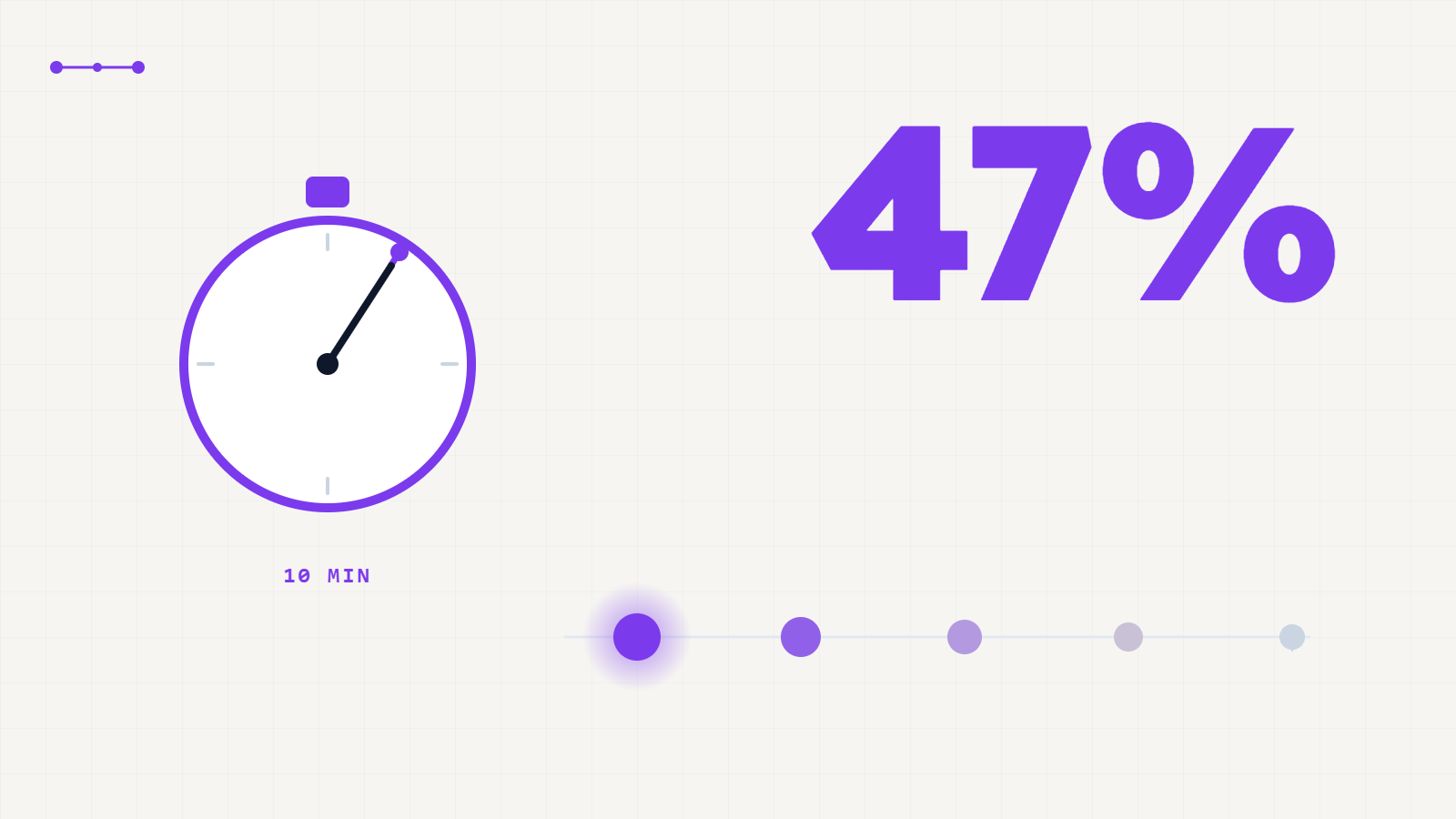
This is a follow-up system problem, not a lead quality problem. In our 3,000+ lead dataset, 47% of missed jobs traced directly to response times over 10 minutes — the homeowner had already reached a competitor who answered first. The remaining failures stack on top: no after-hours coverage, no qualification before the calendar, a single follow-up attempt instead of a multi-touch sequence, and silence after the quote goes out. Fix all five and the same lead volume produces roughly double the booked jobs — with zero added ad spend.
Speed-to-lead is the single largest variable in the entire lead-to-booking process — and it's almost entirely within your control. This isn't a small effect.
| Response window | Approx. contact rate | Share of missed jobs at this window | What's happening on the homeowner's end |
|---|---|---|---|
| Under 5 min | ~80%+ contact rate | Minimal loss | Still on their phone. You're the first voice they hear. Decision starts here. |
| 5 – 10 min | ~55–65% | Low | Probably still available, but has checked one competitor's site while waiting. |
| 10 – 30 min | ~25–35% | 47% of all missed jobs | Has called or messaged 1–2 competitors. The job is likely already spoken for. |
| 30+ min | <15% | High | Has booked an estimate. Your callback goes to voicemail. Lead is effectively dead. |
Based on Web Pinnacles' analysis of 3,000+ contractor leads across roofing, HVAC, solar, plumbing, and remodeling accounts, 2024–2026.
Each failure loses a different slice of your leads — and they compound. A lead that survives a slow response can still die at qualification. One that books can still no-show. Closing the whole chain is what moves the booking rate from 15% to 30%.
That homeowner who filled out your form at 2 PM on Tuesday? They also filled out two competitors' forms. The first contractor who calls wins the estimate appointment — not the best-priced one, not the most experienced one. 47% of missed jobs in our dataset were lost right here. The fix is not "answer faster." It's an automated SMS that fires the moment the form hits, confirming receipt and setting a callback expectation, before any human is free to pick up the phone.
Around 38% of home service inquiries arrive between 6 PM and 10 PM or over the weekend — when your crew has gone home and the office phone rolls to voicemail. Fewer than 20% of homeowners who hit voicemail call back. An automated after-hours response ("We got your message — someone will call first thing tomorrow") doesn't just hold the lead. It signals that you're a professional operation, not someone who checks their phone when they feel like it.
A booked appointment without qualification is a schedule risk disguised as a win. Three questions need confirmed answers before any slot is held: what service they need, whether their location is in your service area, and whether they're ready to move in the next 30 days. Skip these and your tech burns a two-hour estimate drive to discover the homeowner needed a different trade, lived 45 minutes outside your area, or was "just getting prices" with no intention of moving forward.
Most home service leads need 5–8 touches before they book. A homeowner who doesn't answer Tuesday's call isn't dead — they're busy. They're at work. Their kid needed picking up. Most contractors call once, get no answer, and mark the lead as junk. A CRM sequence that delivers a voicemail drop, then a text, then an email, then re-contacts on day 3 and day 7, consistently recovers 20–35% more booked appointments from the exact same lead volume — without spending an extra dollar on ads.
For roofing, HVAC replacement, and remodeling jobs, the decision cycle runs 30 to 90 days after the estimate. Most contractors send a quote and wait. The homeowner mentally files it, gets busy, and eventually books whoever stayed in front of them. You've now paid for the lead, spent a tech's time on the estimate, and handed the job to a competitor who simply followed up twice. A CRM-driven post-quote nurture sequence — three to four touches spread over six weeks — costs nothing per lead and wins jobs that were already yours in everything but follow-through. This is the most expensive silent failure in home service sales, and it's the one most contractors don't know they have because the lost revenue never shows up in any report.
Qualification isn't about rejecting leads — it's about protecting your team's time and ensuring every estimate appointment has a real chance of converting. Three questions. Two minutes. Eliminates the majority of wasted estimate drives.
Confirm exactly what they need done — not what they think the job is called, but what symptom or project they're describing. A homeowner saying "roof repair" might need a full replacement; one saying "AC not working" might have a simple capacitor issue a competitor can solve in an hour.
Verify the address is within your service radius before booking. Out-of-area leads seem small individually — but at 3–4 per month, they're consuming 6–8 estimate slots your in-area pipeline needed. Geographic filtering in the lead form helps; a verbal check closes the gap.
There's a material difference between a homeowner with a leaking roof who needs someone this week and one gathering quotes for a kitchen remodel they're thinking about next spring. Both are real leads — but they belong in different pipelines with different follow-up cadences.
Our Appointment Setting service runs these three checks on every inbound lead before anything touches your calendar. You get a pre-qualified, confirmed appointment — not a gamble.
A lead that doesn't answer the first call isn't a dead lead — it's a lead with a 25–40% booking probability sitting in an inbox with no sequence to activate it. This is the contact cadence that recovers them.
Automated text fires within 5 minutes of form submission. Simple confirmation: "Hi [name], thanks for reaching out. I'll call you in the next few minutes to go over the details." No automation noise — sounds human.
First human call attempt. If no answer: drop a short voicemail (under 30 seconds). "Hi, this is [name] from [company]. You just reached out about [service]. I'd love to talk — call me back at [number] or I'll try you again tomorrow."
Short follow-up text referencing the prior call attempt. "Tried to reach you yesterday about your [roof / HVAC / etc.] — happy to answer questions by text if easier. Still interested in getting an estimate?"
Email delivering your offer or proof. Include a short case study result, a photo of a completed job in their area, or a specific outcome ("We installed 18 HVAC systems in [their city] last summer"). Links directly to the booking page.
Second call attempt followed by a text if no answer. "One more try on the [service] — slots for this week are filling up. Happy to hold one for you." Real scarcity language only if it's true.
Closing re-engagement email. Acknowledge the silence without pressure: "I'll stop reaching out — but if you're still thinking about it, here's how to reach us." Keeps the door open without being pushy. A portion of these reply weeks or months later.
We build and configure the entire follow-up sequence inside GoHighLevel during onboarding — you don't touch it.
This is a follow-up problem, not a traffic problem. The fix doesn't cost a dollar in ad spend — and the upside is immediate.
At a $3,000 average job value, closing the follow-up gap on the same lead volume produces $22,500 in additional revenue every month — from leads you were already paying for and already losing. No new campaigns. No bigger budget. Just catching what's already coming in.
No-shows are the most invisible revenue leak in home services, because you don't get a chance to close a job you never actually ran. Here's what they look like without a system versus with one.
| Trade | Typical no-show rate (no system) | No-show rate (with qualification + reminders) | Monthly impact at 30 estimates |
|---|---|---|---|
| Roofing | 22–30% | 6–10% | Recover 4–6 estimate slots per month |
| HVAC | 18–26% | 5–9% | Recover 3–5 estimate slots per month |
| Solar | 25–35% | 8–12% | Recover 5–7 consultation slots per month |
| Plumbing | 15–22% | 4–8% | Recover 3–4 slots per month |
| Remodeling | 28–38% | 8–13% | Recover 5–7 consultation slots per month |
Ranges based on Web Pinnacles client data and BrightLocal's 2025 local consumer behavior report. Your numbers will vary by market and average job value.
This HVAC client didn't increase their budget. They added the follow-up and appointment-setting layer to the lead flow they already had.
Leads were coming in and quietly disappearing — missed calls, slow callbacks, no after-hours coverage, no sequence to keep warm leads engaged. We layered in missed-call text-back, a 5-minute response protocol, a 7-day follow-up sequence, and human appointment setting with qualification. In 60 days the Google Business Profile alone drove 257 calls and total call volume rose 36.7% — not from new traffic, but from catching what was already arriving.
Book a free audit to see exactly where your leads are leaking — and what closing the gap is worth at your volume.
The exact audit we run before taking on a new client — see where your site is leaking booked jobs.
Book a free 20-minute pipeline audit focused on what happens after the inquiry — response time, follow-up sequence, qualification, no-show rate. That's where the revenue is leaking, and it's the cheapest money you'll ever recover.