
Sewer and drain work is almost entirely emergency-driven. A homeowner searching “sewer backup,” “main line clog,” or “drain repair near me” has water where it shouldn’t be and needs someone today. They tap the phone, look at the three map pack results, and call — often before they finish reading. Studies consistently show the top three map pack positions capture over 70% of clicks for local service queries, and for a same-day emergency the drop-off past position three is even steeper.
That emergency context is what makes ranking a sewer and drain business different from ranking a roofer or a remodeler. The same three Google factors apply — Relevance, Distance, and Prominence — but the weighting shifts toward proximity and instant trust, and the niche has one structural disadvantage most trades don’t: almost every job is a one-time emergency, which starves you of the repeat reviews competitors use to build prominence. This guide works through each factor as it actually applies to sewer and drain contractors.
The core principle
For emergency searches, Google is trying to surface the closest business that a panicking homeowner can trust right now. Win the map pack for sewer and drain work by making your proximity legible (categories + service-area pages) and your trust unmistakable (recent reviews) — in that order.
Why Emergency Intent Changes the Ranking Math for Sewer & Drain
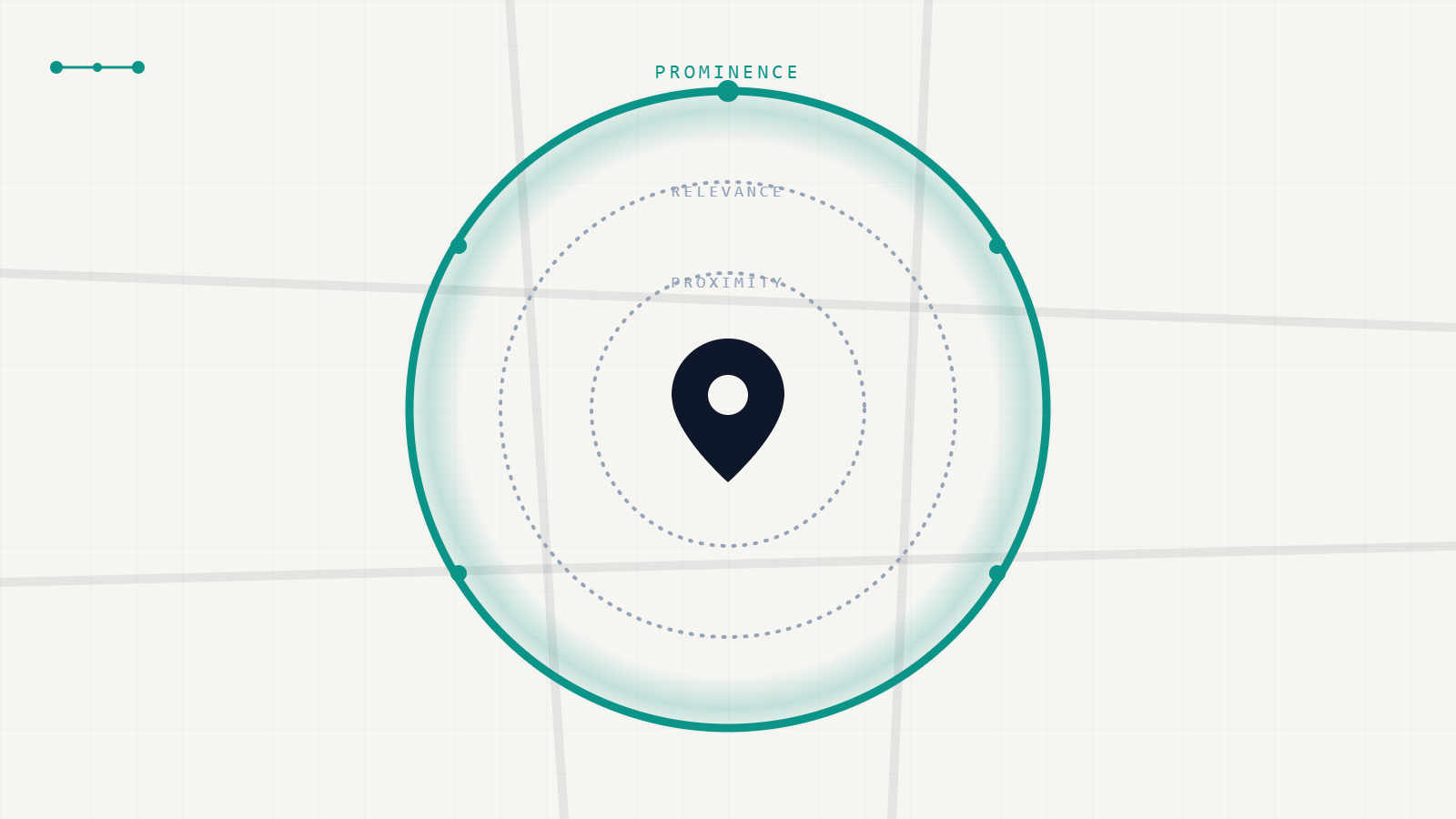
Google documents three factors for local map pack rankings: Relevance, Distance, and Prominence. They aren’t equal in weight, and they’re not equally controllable. For sewer and drain companies the twist is that emergency queries push Google toward whichever qualified business is closest and clearly trustworthy — so Distance and recent-review Prominence carry more weight than they would for a considered purchase like a roof replacement. Here is what each factor measures and which ones you can move.
How well your Google Business Profile and website match the search. When someone searches “sewer line repair [city],” Google asks: does this GBP describe a sewer and drain business serving that city? Your primary category (Drainage service / Plumber), your listed services (hydro jetting, camera inspection, main line repair), and your site content answer that question.
How far your shop is from the searcher — or from the city in the query. You can’t change it, and for emergency “near me” sewer searches it weighs heavily: a homeowner with a flooding basement gets the closest qualified truck. You won’t outrank a competitor physically nearer the searcher, so the response is service-area pages that establish coverage, not profile tweaks.
How well-known and trusted you are across the web — reviews (and how recent they are), citations, backlinks, GBP activity, and behavioral signals like calls and direction requests. For sewer and drain companies, review recency is the prominence lever that matters most and the hardest one to sustain, because the work is one-time rather than recurring.
How the factors interact in a real sewer search
Two drain companies compete for “sewer backup near me” in the same suburb. Both use “Drainage service” as their primary category (Relevance is tied). Both sit within a few miles of the searcher (Distance is roughly equal). The one that wins the call is the one with more recent reviews, a higher owner-response rate, consistent citations, and an active profile — Prominence. When a basement is flooding, Prominence is what decides which of two equally-close, equally-relevant trucks gets dispatched.
Why most sewer & drain companies get stuck
Most fix Relevance once — correct category, complete profile — and stop. Those are one-time improvements. The niche’s real problem is sustaining Prominence when every job is a one-time emergency and no customer ever “comes back next season.” That’s why review velocity has to be engineered into the job itself, not left to chance.
Why Prominence is the Decisive Factor for Sewer & Drain Companies
Prominence is not a single signal — it’s an accumulation across several categories Google weights in its algorithm. For sewer and drain contractors, review signals sit at the top of that list, because emergency searchers scan star ratings and “3 weeks ago” timestamps in the second before they dial. Understanding the components lets you spend your effort where it moves position instead of where it doesn’t.
Review Signals
Star rating, total review count, review velocity (recency), and owner response rate. For a same-day emergency trade like sewer and drain, this is the single highest-weight component of Prominence — and the recency piece is the hard part. Detail covered in Section 3.
Citation Authority
The number of quality directories listing your business with consistent NAP (Name, Address, Phone). Citations are a trust validation signal — they tell Google that other authoritative sources confirm your business exists. Detail in Section 5.
Website Authority
Your website’s domain authority, the relevance of its content to your trade and service area, internal linking structure, and the number and quality of external sites that link to you. Google uses your website as a credibility anchor for your GBP.
GBP Engagement Signals
How often your listing is updated — posts published, photos added, Q&A answered, service descriptions updated. An actively managed GBP signals to Google that the business is operational and engaged. Dormant profiles lose ranking over time.
Behavioral Signals
Clicks to call from your GBP, direction requests, website click-throughs, and booking actions. Google observes how users interact with your listing versus competitors’ listings. A listing that users engage with ranks better over time.
Backlinks & Mentions
Links from local press, industry associations, supplier websites, and home improvement platforms pointing to your website. Also unlinked brand mentions, which Google has confirmed it can understand as relevance signals.
Why Prominence takes longer to move than Relevance
Relevance fixes are immediate: change a category, update a description, add services like hydro jetting or camera inspection. The ranking effect shows within days to a few weeks because Google reads those GBP signals quickly. Prominence is slower. Reviews accumulate over months, citation authority builds over 3–6 months, and backlink authority can take 4–8 months to register. So a sewer and drain company’s Prominence work has to start now, not when you feel ready to rank. The trucks sitting in positions 1–3 today started building that trust months ago.
The most common Prominence mistake: after a slow stretch of storms or a quiet season, blasting out review requests to every past customer at once. 15 reviews landing in a two-week window is a velocity anomaly Google may flag and suppress. For sewer and drain work — where job volume already spikes and dips with weather — review requests must be a steady, drip-paced system, not a catch-up sprint.
The Review Problem With One-Time Jobs — and Why Recency Beats Count
Here is the structural disadvantage of the sewer and drain niche. An HVAC company sees the same customer twice a year and a landscaper sees them monthly — every visit is another chance to ask for a review. You clear a main line once and, if you did your job, the homeowner never needs you again. That one-time nature is why so many sewer companies have a big review count that stopped growing years ago. And Google doesn’t just count reviews — it weighs how recently they arrive as a freshness signal. A company with 94 reviews and none in 5 months reads as “used to be busy.” One with 60 reviews and 4 this month reads as “clearing drains right now.”
Last review: 6 months ago. Star rating: 4.7. Zero reviews in the past 90 days. Owner response rate: 12%. Google reads this as a business that may no longer be actively operating or satisfying customers at its historical rate.
4 reviews in the last 30 days. Star rating: 4.8. 11 reviews in the past 90 days. Owner response rate: 94%. Google reads this as an active, customer-engaged business performing consistently well — right now.
What the recency window actually looks like
Based on observed ranking patterns, Google weights reviews within the last 30–60 days most heavily, with reviews from the past 6 months still contributing meaningfully. Reviews older than 12 months contribute to your aggregate score but carry minimal freshness weight. This means review generation is not a project you complete — it’s a system you run permanently.
Target velocity by market competitiveness
Low-competition market (suburban, smaller city): 2–3 reviews per month to maintain and grow position.
Medium-competition market: 3–5 reviews per month to gain ground on established competitors.
High-competition market (major metro): 5–8+ reviews per month, with active owner responses within 24 hours, to compete at positions 1–3.
How to build a review velocity system — not a review campaign
One operational note
Response rate on reviews is more important than many contractors realise. A business that receives 60 reviews and responds to all 60 consistently outperforms — in engagement signals — a business that receives 80 reviews and responds to 20. Set aside 10 minutes per week for review management. For clients using GoHighLevel, responses can be drafted in the CRM dashboard.
The GBP Categories That Decide Sewer & Drain Visibility
Your GBP primary category is the single most controllable ranking variable in your entire local SEO presence, and for sewer and drain work it’s where most companies quietly lose. It tells Google — with a directness no other signal matches — exactly what you do, and it controls which searches can trigger your listing. Pick it wrong and you don’t just rank lower; you become structurally ineligible to appear for “sewer line repair near me” at all.
The most common category mistake for sewer & drain companies: defaulting to a broad category or the wrong specialty. A drain specialist listed as “Plumber” competes against every general plumber in town instead of owning drain intent; one listed as “Contractor” won’t surface for emergency drain searches at all. And a company that does mostly excavation/main-line work but lists “Plumber” misses the searches that match its highest-value jobs. Match the primary category to where your revenue actually comes from.
Primary category: the one that matters most
Google allows one primary category. This is the category Google weighs most heavily when matching your listing to search queries. It should be the most specific, most accurate description of your core business offering — not what sounds most impressive, and not a broad umbrella term.
| Your core work | Correct Primary Category | Common Mistakes | Why It Matters |
|---|---|---|---|
| Drain cleaning / clogs | Drainage service | Plumber Contractor | “Drainage service” owns drain intent; “Plumber” buries you among every general plumber in town. |
| Full-service plumbing + drains | Plumber | Contractor Handyman | “Plumber” triggers emergency searches; “Contractor” does not surface for “emergency plumber near me.” |
| Sewer line repair / replacement | Plumber + Excavating contractor | Construction company | Pairing plumbing with excavation matches both “sewer line repair” and dig/trenchless queries. |
| Septic service | Septic system service | Plumber only | “Septic system service” is the only category that triggers “septic pumping / repair near me.” |
Secondary categories: expanding your query footprint
Google allows up to 10 total categories (1 primary + 9 secondary). Secondary categories widen the range of searches that can trigger your listing. The rule: add every secondary category that accurately describes a service you actually perform — and no more, since Google cross-references your website and reviews to check.
Sewer & drain secondary categories — what you’re likely missing
A drain company running only Drainage service as its single category is invisible for: “sewer line repair near me” · “septic pumping” · “hydro jetting service” · “emergency plumber.” Add the secondary categories that match your work — Plumber, Septic system service, Excavating contractor, Sewage disposal service, and Water damage restoration service if you handle backups — to unlock visibility for each of those query types.
Services list: the long-tail layer most sewer companies ignore
Beneath categories, GBP lets you list individual services with descriptions. Google indexes these and uses them to match long-tail queries. A drain company that lists “Hydro Jetting,” “Sewer Camera Inspection,” “Trenchless Sewer Repair,” and “Main Line Clog Clearing” — each with a real 100–150 word description — is far more likely to appear for those exact searches than one with an empty services section. Fill every service you offer, and write actual descriptions, not one-liners. It takes about two hours and shows up in 30–60 days.
Citations and NAP Consistency: The Trust Validation Layer
A citation is any online mention of your business’s Name, Address, and Phone number. Google uses citations to validate the information in your GBP — cross-referencing your listing against what other authoritative sources say about your business. If those sources are consistent and numerous, Google increases its confidence that your GBP data is accurate and that your business is legitimate. If they’re inconsistent or sparse, the opposite occurs.
What NAP consistency actually means — and why small inconsistencies matter
NAP = Name, Address, Phone. These three data points must be identical across every directory, not just approximately the same. What counts as an inconsistency:
Yelp: Rooter Pro Sewer and Drain LLC | 123 Main St | (512) 400-1234
BBB: Rooter Pro Drain | 123 Main Street, Suite 1 | 512-400-1234
Angi: Rooter Pro Sewer & Drain | 123 Main St. | (512) 400-1235
✓ Consistent NAP (how it should look everywhere): All: Rooter Pro Sewer & Drain | 123 Main Street | (512) 400-1234
Each inconsistency is a small conflicting signal. Individually they barely matter. Accumulated across 30+ directories, they create enough noise in Google’s data to suppress rankings. The fix is an audit: find every directory where your business is listed, and correct the NAP to match your GBP exactly.
Citation quality tiers for home service contractors
Not all citations carry the same weight. High-authority directories with strong domain authority and strong local relevance contribute more to your Prominence score. Prioritise in this order:
Major platforms with strong domain authority and widespread use. Google cross-references these heavily.
Home service and contractor-specific platforms. Industry relevance makes these particularly valuable for map pack Prominence.
Local directories, chamber of commerce listings, and general business directories. Lower individual authority but contribute to citation volume.
Citation velocity: pace this correctly
Building 60 new citations in a single week looks unnatural and may be flagged as manipulative. The safe build pace is 5–10 new citations per week, starting with Tier 1 and working down. At that rate, you can build a comprehensive 60-citation profile in 6–12 weeks — which is exactly the right timeline for sustainable ranking improvement.
How Service Area Pages on Your Website Support GBP Rankings
This is one of the most persistently misunderstood areas of local SEO for contractors. The question comes up in virtually every discovery call: “I set my service area in my GBP to cover all of greater Houston — why do I only rank in my immediate neighbourhood?” The answer requires understanding what GBP service area settings actually do — and what they don’t do.
The critical distinction every contractor needs to understand
GBP service area settings control how your listing is displayed — they hide your address and list the cities you serve in your profile description. They do NOT create ranking signals in those cities. Setting your service area to cover 40 cities does not make you rank in those 40 cities. Distance is the ranking factor, and your physical address is the reference point Google uses for it.
What actually creates ranking presence in cities beyond your address
To rank in cities beyond your business address, you need service area landing pages on your website. These are dedicated pages targeting a specific city and service combination — for example, “Sewer Line Repair in Round Rock TX” or “Drain Cleaning in Pflugerville.” These pages create the relevance and Prominence signals that let Google associate your GBP with searches in that location, even when Distance is working against you.
The mechanism works like this: Google reads your website to build a relevance model for your GBP. When your website contains a high-quality page specifically about your services in a particular city, it strengthens the relevance signal for searches in that city. Over time — typically 90–180 days — this can produce map pack visibility in cities where your physical address would otherwise prevent it.
What makes a service area page work vs what Google ignores
✓ High-quality service area page
areaServed set to that city✗ Thin page Google will ignore (or penalise)
The GBP post connection
GBP posts can reference specific cities you serve — a cleared main line in one town, a trenchless replacement in another, or service availability in a new area. These posts create a direct, GBP-level signal tying your listing to those cities. Use them alongside service area pages, not instead of them. A GBP post about a sewer job completed in Katy, TX, backed by a service-area page for sewer repair in Katy, TX, creates two reinforcing signals rather than one.
Publication pace for service area pages
Publish 1–2 genuinely well-written service area pages per week. At that rate, you can build a 20-city service area architecture in 10–20 weeks. Do not publish 20 pages simultaneously — it looks like a thin content push and Google is unlikely to index them promptly. Gradual, consistent publication is both faster to rank and safer in terms of algorithm signals.
What Actually Moves the Needle: 90-Day Wins vs the 6-Month Build
Understanding the algorithm is useful. Knowing which levers to pull first — and in what sequence — is what produces rankings. The actions below are ordered by speed of impact. Some produce visible ranking movement within 2–4 weeks. Others are necessary foundations whose effects compound over months. Both categories are non-negotiable.
Moves the needle by the end of month 3
These actions produce visible ranking movement quickly because they are direct GBP signals Google reads fast.
Compounds over months — positions you for dominance
These are the Prominence signals that separate position 1 from position 3 in competitive markets. They cannot be shortcut.
The honest timeline for competitive markets
If you are starting from a weak map pack position (4–7, or not appearing), with fewer than 20 reviews, inconsistent citations, and no service area pages: expect meaningful position improvement within 60–90 days from completing the 90-day actions above, and top-3 stability within 6–9 months of sustained Prominence building in most markets. High-competition metros (Dallas, Houston, Phoenix, Miami, LA) may require 12+ months to reach top-3 stability against entrenched competitors. There is no legitimate shortcut — but there is a correct sequence, and the sequence above is it.
The Bottom Line for Sewer & Drain Companies
The map pack algorithm isn’t mysterious, and for sewer and drain work the priorities are clear. Get your category right so you’re eligible for drain and sewer intent, make your coverage legible with service-area pages so proximity works for you, and — above all — solve the one-time-job review problem so a steady stream of recent reviews keeps your Prominence fresh. You can’t change your location and you can fix relevance in a day, but review velocity is the real game, and it’s won by companies that engineer the review request into every emergency call.
The drain companies sitting in positions 1–3 in your market aren’t there by luck. Somewhere in the last 6 to 24 months they built the review and citation signals that now anchor those spots. The question is whether you start building yours today — or keep sending the next flooded-basement call to the competitor who did.
Want us to audit your current map pack position?
We review your GBP, current rankings, citation gaps, review velocity, and competitor Prominence — and tell you exactly what to fix first.
Frequently Asked Questions
Map pack visibility is Stage 1 of the Booked-Job Pipeline™. Web Pinnacles runs Local SEO for plumbing, built to move calls and booked jobs, not rankings alone. See all of our home service marketing services.