
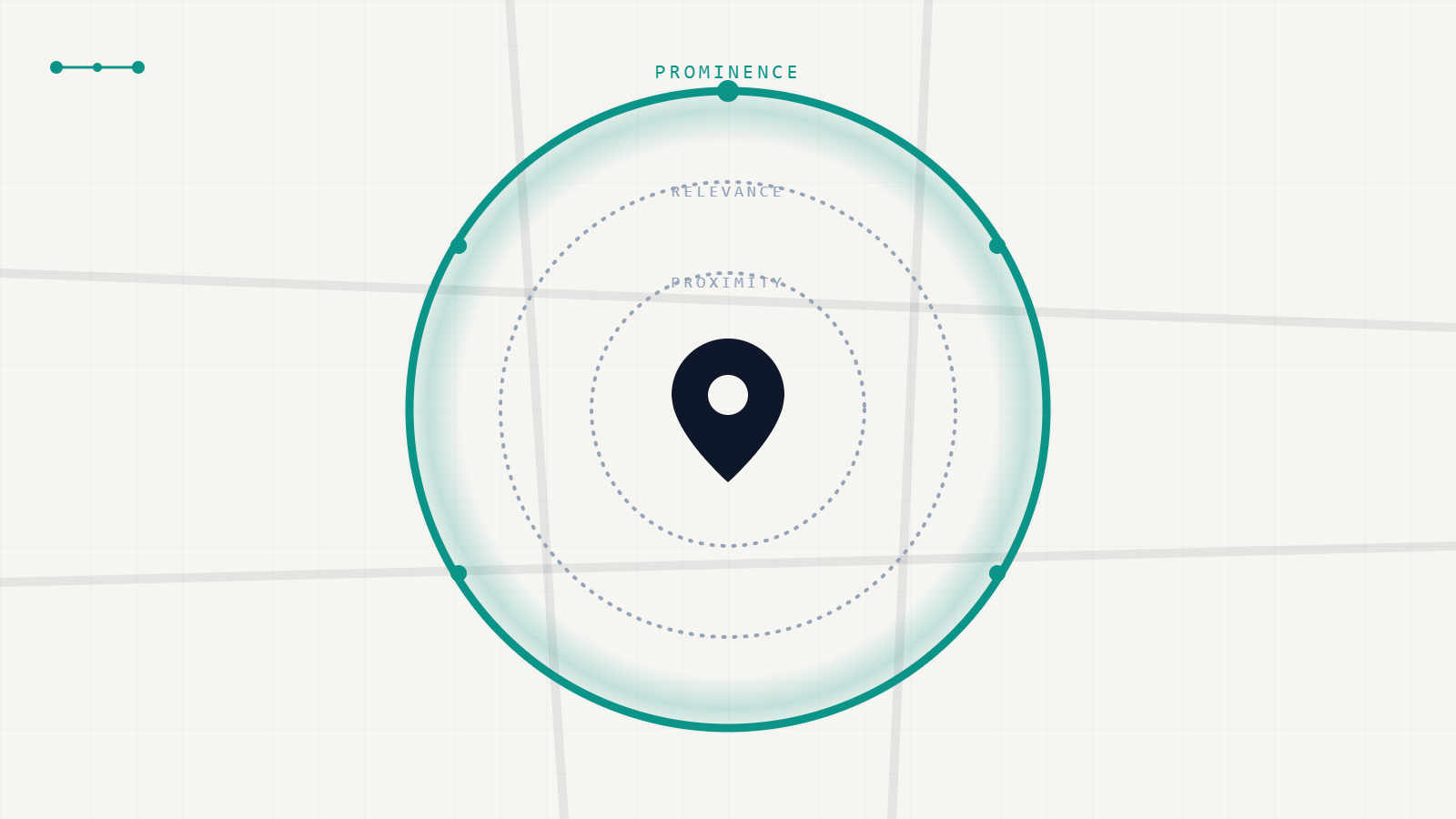
Plumbing carries a search-intent split most trades don't have to manage on one profile. A burst pipe or a backed-up sink is a same-day emergency — the homeowner searches, sees the map pack, and calls the first business that answers. A water heater replacement or a repipe is a considered purchase — the homeowner compares two or three quotes over several days before deciding. Both searches route through the exact same Google Business Profile, and optimizing for only one of them means quietly losing the other.
The same three Google factors govern both: Relevance, Distance, and Prominence. But the weighting shifts by query type — emergency searches lean on Distance and review recency, installation searches lean on Relevance and total review depth. This guide works through each factor with that split in mind, and how to structure one GBP to win both without either search type cannibalizing the other's optimization.
The core principle
For plumbing, Google is trying to surface the closest trustworthy business for emergency calls, and the most credible, well-documented business for installation and repipe searches. Win both by structuring your GBP services list, service-area pages, and review requests to explicitly serve both intents — not by choosing one and letting the other atrophy.
Why Dual Intent Changes the Ranking Math for Plumbers
Google documents three factors for local map pack rankings: Relevance, Distance, and Prominence. For plumbing, the weighting shifts depending on which of the two searches a homeowner is running. An “emergency plumber near me” search behaves like any proximity-driven emergency trade — Distance and recent-review Prominence dominate, and the top three map pack positions capture over 70% of clicks on that query type. A “water heater installation cost” search behaves like a considered purchase, where Relevance (does your GBP clearly describe installation work?) and total review depth carry more weight than which truck is physically closest.
How well your GBP and website match the search. This is where dual intent matters most: a profile listing only "drain cleaning" and "leak repair" as services is structurally invisible for "water heater installation," even with a perfect Plumber category. Your services list has to name both job types explicitly.
How far your shop is from the searcher. You can't change it, and for a burst-pipe emergency it weighs heavily: the homeowner gets the closest qualified plumber. It matters far less for a considered installation search, where the homeowner is willing to wait for the right quote regardless of exact distance.
How well-known and trusted you are across the web. For emergency searches, review recency matters most — a panicked homeowner scans "3 weeks ago" timestamps. For installation searches, review depth and detail matter more — a homeowner comparing quotes reads what past installation customers actually said.
How the factors interact across both search types
Two plumbing companies compete for "emergency plumber near me" on a Saturday night. Both use "Plumber" as their primary category (Relevance is tied). Both sit within a few miles of the searcher (Distance is roughly equal). The one with more recent reviews and a faster owner-response rate wins the call — Prominence, weighted toward recency. Run the same comparison three weeks later for "repipe cost [city]," and the company with more total reviews mentioning installation work, plus a website page that actually describes the repipe process, wins the click instead — Prominence, weighted toward depth. Same two levers, different weighting, same GBP.
Why most plumbing companies get stuck
Most plumbing companies build their entire GBP and website around emergency intent — because that's the loudest, most immediate revenue — and leave installation and repipe work as an afterthought with a single generic services line. That leaves real revenue on the table: installation and repipe jobs run larger tickets than a service call, and the searches for them are largely uncontested by companies that never bothered to optimize for them.
Why Prominence Is the Decisive Factor for Plumbing Companies
Prominence is an accumulation across several categories Google weights in its algorithm. For plumbing, review signals sit at the top for both intent modes — just measured differently. Understanding the components lets you spend effort where it moves position for both search types, not just the louder one.
Review Signals
Star rating, total review count, review velocity (recency), and owner response rate. For plumbing, recency wins the emergency search; total depth and installation-specific mentions win the considered-purchase search. Detail in Section 3.
Citation Authority
The number of quality directories listing your business with consistent NAP. Citations validate that other authoritative sources confirm your business exists. Detail in Section 5.
Website Authority
Your website's domain authority and the relevance of its content. Especially important for installation and repipe searches, where a homeowner is far more likely to click through and read before calling than during an emergency.
GBP Engagement Signals
How often your listing is updated — posts, photos, Q&A, service descriptions. Posting about both emergency response and completed installations signals to Google (and to homeowners scanning your profile) that you actively do both.
Behavioral Signals
Clicks to call, direction requests, website click-throughs, and booking actions. Google observes how users interact with your listing versus competitors over time.
Backlinks & Mentions
Links from local press, supplier and manufacturer sites, and home improvement platforms pointing to your website. Water heater manufacturer dealer/installer directories are a plumbing-specific opportunity many companies never claim.
Why Prominence takes longer to move than Relevance
Relevance fixes are immediate: update your services list to name both intents, add a category, rewrite a description. Prominence is slower — reviews accumulate over months, citation authority builds over 3–6 months. A plumbing company's Prominence work has to serve both intent modes simultaneously — asking for a review after an emergency call and after a repipe job are two different asks with two different framings, covered in Section 3.
The most common Prominence mistake for plumbers: a review profile that's entirely emergency-flavored ("came fast," "fixed it same day") with zero mentions of installation or repipe work. A homeowner researching a $6,000 repipe reads that review set and sees no evidence the company has ever done one — even if it has, extensively.
Review Strategy Split by Job Type
Most plumbing companies run one review-request script for every job. That produces a review profile skewed entirely toward whichever job type is more frequent — usually emergency repairs, since they happen far more often than installations. The fix isn't asking for more reviews; it's asking two different ways, matched to what the next reader of that review actually needs to see.
"Thanks for choosing us, please leave a review!" sent identically after every job. 94 reviews, nearly all mentioning speed and emergency response, none mentioning installation quality, warranty, or repipe work — even though 30% of completed jobs were installations.
Emergency-job text emphasizes speed and relief; installation-job text asks specifically about the quote process and finished work. Resulting review profile has both recency (emergency mentions) and depth (installation-specific detail) — winning both search types.
What each script should actually ask
The mechanism is simple: the request text sent after a job should nudge the customer toward mentioning what future searchers of that exact job type need to see. Google doesn't read your CRM tag for "emergency" vs. "installation" — it reads the review text itself, so what the customer writes matters more than how you categorized the job internally.
Target velocity by market competitiveness
Low-competition market: 2–3 reviews per month across both job types.
Medium-competition market: 3–5 reviews per month, deliberately mixed between emergency and installation framing.
High-competition market: 5–8+ reviews per month with active owner responses, split roughly to match your actual job mix so neither search intent goes unsupported.
One operational note
If your job mix runs 70% emergency and 30% installation, your review mix should roughly reflect that — not 95% emergency because those requests are automated and installation requests get forgotten. Audit your last 50 reviews by job type; if the ratio is badly skewed from your actual revenue mix, that's the gap costing you installation-search visibility.
The GBP Categories That Decide Plumbing Visibility
Your GBP primary category is the single most controllable ranking variable, and for plumbing it has to accommodate both intent modes. Pick it wrong or leave secondary categories thin, and you become structurally ineligible for entire categories of search — usually the installation side, since it's the one most companies neglect.
The most common category mistake for plumbing companies: using only "Plumber" with no secondary categories that signal installation capability, or a drain-focused company leaving off "Drainage service" and quietly losing to competitors who specifically claim that category for drain-intent searches.
Primary category: the one that matters most
Google allows one primary category. It should be the most specific, accurate description of your core business offering.
| Your core work | Correct Primary Category | Common Mistakes | Why It Matters |
|---|---|---|---|
| Full-service residential plumbing | Plumber | Contractor Handyman | "Plumber" triggers both emergency and installation search intent; "Contractor" doesn't surface for either reliably. |
| Drain-heavy plumbing business | Plumber + Drainage service | Plumber only | Adding "Drainage service" as secondary claims drain-specific intent that a Plumber-only listing partially misses. |
| Water heater installation focus | Plumber + Hot water system supplier | Plumber only | "Hot water system supplier" is the category that directly matches "water heater installation" query intent. |
| Water damage / backup restoration | Water damage restoration service | Plumber only | A dedicated secondary category surfaces you for restoration-specific searches a general Plumber listing won't catch. |
Secondary categories: expanding your query footprint
Google allows up to 10 total categories. The rule: add every secondary category that accurately describes a service you actually perform — this is the single fastest fix for the installation side of the dual-intent problem.
Plumbing secondary categories — what you're likely missing
A plumbing company running only Plumber as its single category is invisible for: “water heater installation” · “drain cleaning service” · “sewer line repair” · “water damage restoration.” Add secondary categories that match your work — Hot water system supplier, Drainage service, and Water damage restoration service — to unlock visibility for each of those query types.
Services list: the long-tail layer most plumbing companies ignore
GBP lets you list individual services with descriptions, and Google indexes these for long-tail matching. A plumbing company that lists “Emergency Leak Repair,” “Water Heater Installation,” “Repiping,” “Drain Cleaning,” and “Fixture Installation” — each with a real 100–150 word description — is far more likely to appear for both intent types than one with a single generic "Plumbing Services" line. List installation services with the same detail as emergency services — that asymmetry is exactly where most plumbing GBPs lose the considered-purchase search.
Citations and NAP Consistency: The Trust Validation Layer
A citation is any online mention of your business's Name, Address, and Phone number. Google cross-references your GBP against these sources to validate accuracy. Consistent, numerous citations increase Google's confidence in your listing; inconsistent or sparse ones do the opposite.
What NAP consistency actually means
NAP must be identical across every directory, not just approximately the same:
Yelp: Reliable Plumbing Company | 789 Elm St | (512) 400-9012
BBB: Reliable Plumbing | 789 Elm Street, Ste 3 | 512-400-9012
Angi: Reliable Plumbing Co | 789 Elm St. | (512) 400-9013
✓ Consistent NAP (how it should look everywhere): All: Reliable Plumbing Co. | 789 Elm Street | (512) 400-9012
Each inconsistency is a small conflicting signal. Accumulated across 30+ directories, they create enough noise to suppress rankings. The fix is an audit: find every listing and correct the NAP to match your GBP exactly.
Citation quality tiers for plumbing contractors
Not all citations carry the same weight. Prioritise in this order:
Major platforms with strong domain authority and widespread use.
Home service and plumbing-specific platforms, including water heater manufacturer installer directories.
Local directories, chamber of commerce listings, and general business directories.
Citation velocity: pace this correctly
Building 60 new citations in a single week looks unnatural and may be flagged as manipulative. The safe build pace is 5–10 new citations per week, starting with Tier 1 and working down. Water heater manufacturer installer directories in Tier 2 are worth claiming if you're a certified installer — most plumbing companies never do.
How Service Area Pages on Your Website Support GBP Rankings
This comes up in nearly every plumbing discovery call: “I set my service area in my GBP to cover the whole county — why do I only rank near my shop?” The answer requires understanding what GBP service area settings actually do, and don't do.
The critical distinction every plumbing contractor needs to understand
GBP service area settings control how your listing is displayed — they hide your address and list the cities you serve. They do NOT create ranking signals in those cities. Setting your service area to cover 30 cities does not make you rank in those 30 cities. Distance is the ranking factor, and your physical address is the reference point Google uses for it.
What actually creates ranking presence in cities beyond your address
To rank in cities beyond your address, you need service area landing pages on your website — dedicated pages targeting a specific city and service combination, such as “Emergency Plumber in Round Rock TX” or “Water Heater Installation in Pflugerville.” These pages create relevance and Prominence signals that let Google associate your GBP with searches in that location, even when Distance is working against you.
Because plumbing serves both emergency and installation intent, the strongest service area pages address both explicitly in the same page: an emergency-availability section and an installation/repipe section for that specific city, rather than one generic "plumbing services" page that mentions neither clearly.
What makes a service area page work vs what Google ignores
✓ High-quality service area page
areaServed set to that city✗ Thin page Google will ignore (or penalise)
Publication pace for service area pages
Publish 1–2 genuinely well-written service area pages per week. Do not publish 20 pages simultaneously — it looks like a thin content push. Gradual publication is both faster to rank and safer under Google's spam signals.
What Actually Moves the Needle: 90-Day Wins vs the 6-Month Build
Understanding the algorithm is useful. Knowing which levers to pull first is what produces rankings. The actions below are ordered by speed of impact.
Moves the needle by the end of month 3
Direct GBP signals Google reads fast.
Compounds over months — positions you for dominance
The Prominence signals that separate position 1 from position 3.
The honest timeline for competitive markets
Starting from a weak map pack position (4–7 or not appearing), with fewer than 20 reviews and a services list that only names emergency work: expect meaningful position improvement on emergency queries within 60–90 days, and installation-query visibility within 4–6 months once the services list, categories, and review mix catch up. High-competition metros may take 12+ months for top-3 stability on either. There's no shortcut — but the sequence above, applied to both intents, is the correct one.
The Bottom Line for Plumbing Companies
The map pack algorithm isn't mysterious, and for plumbing the priorities are clear — with one wrinkle no other trade on this site has to manage: one GBP has to win two different searches. Get your categories and services list to name both emergency and installation work explicitly, make your coverage legible with service-area pages that address both, and split your review requests so neither intent goes unsupported by a skewed review profile.
The plumbing companies sitting in positions 1–3 for both "emergency plumber near me" and "water heater installation [city]" in your market didn't get there by accident — most companies only ever optimize for one. The question is whether you build for both starting today, or keep leaving the higher-ticket installation searches to whoever else in your market bothered to claim them.
Want us to audit your current map pack position?
We review your GBP, current rankings, citation gaps, review velocity, and competitor Prominence — and tell you exactly what to fix first.
Frequently Asked Questions
Map pack visibility is Stage 1 of the Booked-Job Pipeline™. Web Pinnacles runs Local SEO for plumbing, built to move calls and booked jobs, not rankings alone. See all of our home service marketing services.