
HVAC is the rare trade with two completely different search-intent modes competing for the same Google Business Profile. A homeowner whose AC just died searches “AC repair near me” or “emergency HVAC repair” and needs an answer today — the same emergency pattern as a burst pipe. But a homeowner replacing a 15-year-old furnace searches “furnace replacement cost [city]” weeks before they buy, comparing quotes the way they’d compare contractors for a roof. The top three map pack positions capture over 70% of clicks on local service queries for both search types — but the ranking mechanics that win each one aren’t identical.
That dual-demand problem is what makes ranking an HVAC company different from ranking a plumber or a sewer specialist. The same three Google factors apply — Relevance, Distance, and Prominence — but HVAC has a structural advantage most companies waste: unlike one-time emergency trades, HVAC customers come back twice a year for maintenance, which should make review velocity the easiest part of this business to sustain. Most companies still let it lapse. This guide works through each factor as it actually applies to HVAC contractors.
The core principle
For HVAC, Google is trying to surface the closest trustworthy business for emergency searches, and the most credible, well-reviewed business for considered system-replacement searches. Win both by keeping your GBP category and services structured for emergency repair work, and your review velocity running through the shoulder seasons — not just during the summer and winter peaks.
Why Dual Seasonal Demand Changes the Ranking Math for HVAC
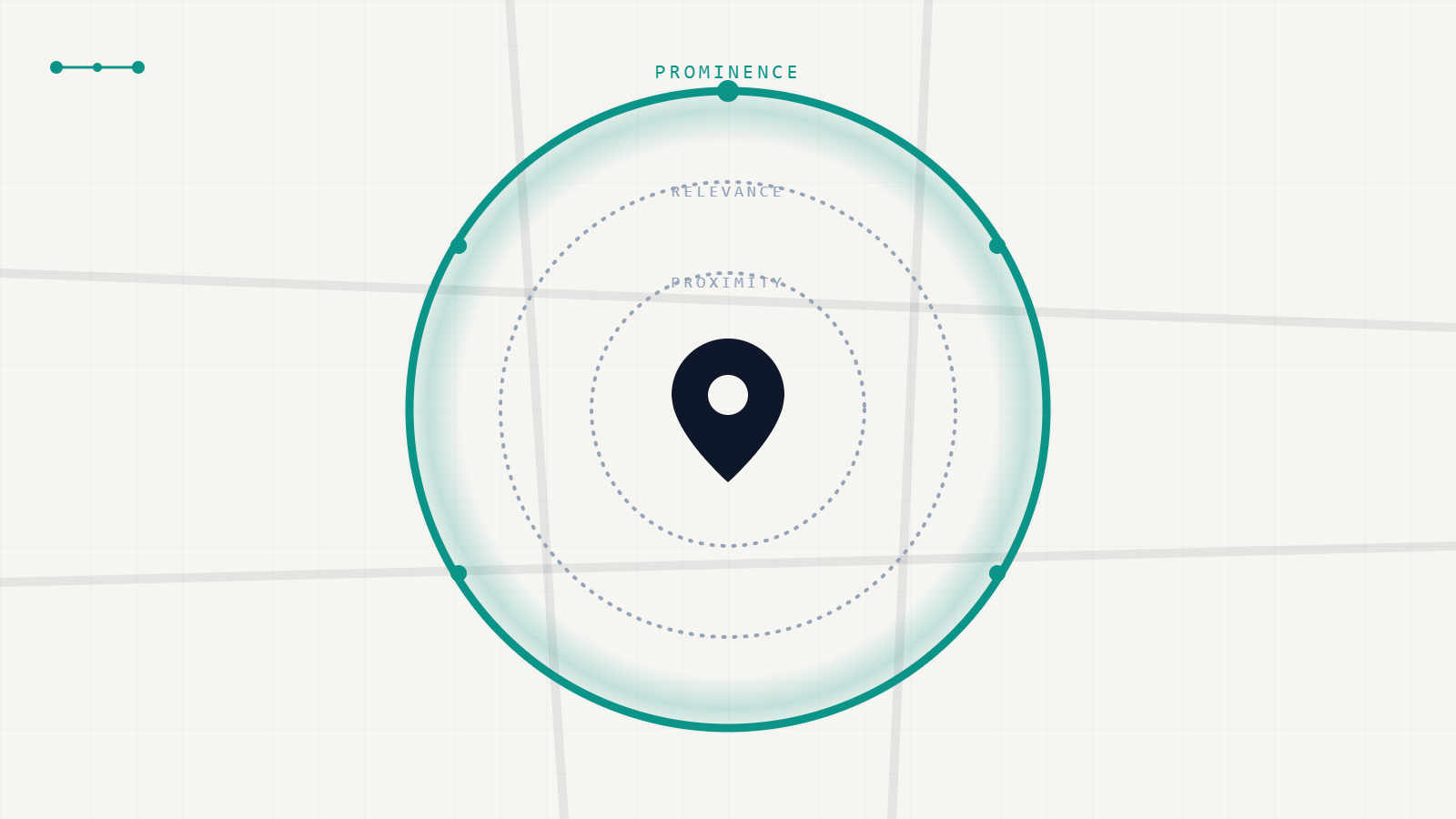
Google documents three factors for local map pack rankings: Relevance, Distance, and Prominence. For HVAC, the weighting shifts depending on which search a homeowner is running. An “AC not cooling” emergency search behaves like any proximity-driven trade — Distance and recent-review Prominence dominate. A “new HVAC system cost” search behaves more like a considered purchase, where website authority, service descriptions, and total review volume carry more weight than which truck is physically closest. Here is what each factor measures and which ones you can move.
How well your Google Business Profile and website match the search. When someone searches “furnace repair [city],” Google asks: does this GBP describe an HVAC business serving that city, offering that exact service? Your primary category, your listed services (AC repair, furnace repair, duct cleaning, system installation), and your site content answer that question.
How far your shop is from the searcher — or from the city in the query. You can’t change it, and for “AC repair near me” during a summer heat wave it weighs heavily: the homeowner gets the closest qualified truck. You won’t outrank a competitor physically nearer the searcher, so the response is service-area pages, not profile tweaks.
How well-known and trusted you are across the web — reviews (and how recent), citations, backlinks, GBP activity, and behavioral signals like calls and direction requests. For HVAC, sustained review recency matters more than for most trades, because the same profile has to look active in July and in February.
How the factors interact in a real HVAC search
Two HVAC companies compete for “AC repair near me” in the same neighborhood in August. Both use “HVAC contractor” as their primary category (Relevance is tied). Both sit within a few miles of the searcher (Distance is roughly equal). The one that wins the call is the one with more recent reviews, faster owner responses, and an active profile — Prominence. But run the same comparison for “furnace replacement cost” three months later, and the company with more total reviews, better service descriptions, and stronger website content for system replacement work wins the click instead. The same two levers decide both outcomes; the weighting between them just shifts by query type.
Why most HVAC companies get stuck
Most HVAC companies optimize their GBP once for emergency repair intent and never revisit it for replacement-purchase intent, or the reverse. The niche’s real problem is treating “Local SEO” as one job instead of two overlapping ones — the profile has to win a same-day emergency call and a multi-week considered purchase from the exact same listing.
Why Prominence is the Decisive Factor for HVAC Companies
Prominence is an accumulation across several categories Google weights in its algorithm. For HVAC, review signals sit at the top, because both emergency searchers (scanning star ratings before dialing) and considered-purchase searchers (reading recent reviews as social proof for a big-ticket decision) rely on them — just for different reasons. Understanding the components lets you spend effort where it moves position instead of where it doesn’t.
Review Signals
Star rating, total review count, review velocity (recency), and owner response rate. For HVAC this is the highest-weight component of Prominence in both intent modes — and sustaining velocity across shoulder seasons is the hard part. Detail in Section 3.
Citation Authority
The number of quality directories listing your business with consistent NAP. Citations validate that other authoritative sources confirm your business exists. Detail in Section 5.
Website Authority
Your website's domain authority, the relevance of its content to your trade and service area, internal linking, and the number and quality of external sites that link to you. Especially relevant for winning the considered-purchase side of HVAC search.
GBP Engagement Signals
How often your listing is updated — posts, photos, Q&A, service descriptions. A profile that keeps posting through the shoulder seasons signals to Google that the business stays operational year-round, not just at peak.
Behavioral Signals
Clicks to call, direction requests, website click-throughs, and booking actions. Google observes how users interact with your listing versus competitors' listings over time.
Backlinks & Mentions
Links from manufacturer partner directories (Trane, Carrier, Lennox dealer locators), local press, and home improvement platforms pointing to your site. Dealer-locator links are a distinctly HVAC-specific backlink opportunity most companies never claim.
Why Prominence takes longer to move than Relevance
Relevance fixes are immediate: change a category, update a description, add services. The effect shows within days to a few weeks. Prominence is slower — reviews accumulate over months, citation authority builds over 3–6 months, backlink authority over 4–8 months. An HVAC company’s Prominence work has to run continuously, including the months when the phone isn’t ringing off the hook — because the companies sitting in positions 1–3 when the next heat wave hits started building that trust in the quiet months before it.
The most common Prominence mistake for HVAC: review requests that spike during peak season and vanish in the shoulder months. A profile with 18 reviews in July and zero in September and October reads as seasonal to Google — and by the time the next peak hits, that dormant stretch has already cost Prominence ground to competitors who kept a steady drip going through maintenance visits.
The Maintenance-Plan Review Advantage Most HVAC Companies Waste
Here is HVAC’s structural advantage over one-time-emergency trades like sewer and drain repair: a customer on a maintenance plan sees your technician twice a year, every year — a spring AC tune-up and a fall furnace check. That's two guaranteed review-request touchpoints per customer per year, indefinitely, regardless of whether anything actually broke. Most sewer and drain companies would consider that a luxury. Most HVAC companies still don’t use it, because the maintenance visit gets treated as routine and the review ask only happens after an emergency repair.
Last review: 4 months ago. Star rating: 4.6. Zero reviews since the summer peak ended. 340 active maintenance-plan customers never asked for a review during their fall tune-up visits. Google reads this as a business coasting on past reputation.
6 reviews in the last 30 days — in October, the off-season. Star rating: 4.9. Every maintenance-plan visit triggers a review-request text. Google reads this as an active, consistently engaged business, year-round.
What the recency window actually looks like
Based on observed ranking patterns, Google weights reviews within the last 30–60 days most heavily, with reviews from the past 6 months still contributing meaningfully. For HVAC specifically, this means the shoulder-season months (April–May, September–October) are exactly when maintenance-plan review requests matter most — they're what keeps the recency window from going cold between peaks.
Target velocity by market competitiveness
Low-competition market: 2–3 reviews per month, sustained year-round via maintenance visits.
Medium-competition market: 3–5 reviews per month, with an emergency-repair request layered on top of maintenance-plan requests.
High-competition market (major metro): 5–8+ reviews per month, with active owner responses within 24 hours, to compete at positions 1–3 through every season.
How to build a review velocity system around maintenance visits
One operational note
A maintenance-plan base is a review-velocity engine most other trades don’t have. A company with 400 active plan customers serviced twice yearly has 800 built-in review-request opportunities a year before a single emergency call comes in. Treat plan renewals and tune-ups as review touchpoints, not just service touchpoints.
The GBP Categories That Decide HVAC Visibility
Your GBP primary category is the single most controllable ranking variable, and for HVAC it has to serve both intent modes at once. It tells Google exactly what you do and controls which searches can trigger your listing. Pick it wrong and you don't just rank lower — you become structurally ineligible for entire categories of search.
The most common category mistake for HVAC companies: using only "HVAC contractor" as the sole category when the business also does significant light-commercial work, or splitting the emphasis so heavily toward installation that "Air conditioning repair service" never gets added as a secondary — which quietly excludes the business from the highest-volume emergency query type it should be winning.
Primary category: the one that matters most
Google allows one primary category. It should be the most specific, accurate description of your core business offering.
| Your core work | Correct Primary Category | Common Mistakes | Why It Matters |
|---|---|---|---|
| Full-service residential HVAC | HVAC contractor | Contractor Handyman | "HVAC contractor" is the broadest correct term that still triggers emergency and installation searches alike. |
| AC repair & installation focus | Air conditioning contractor | HVAC contractor only | Pairs with the secondary "Air conditioning repair service" to own both installation and emergency repair intent. |
| Heating-only or dual fuel | Heating contractor | HVAC contractor only | Ensures visibility for "furnace repair" and "heating contractor near me" searches specifically. |
| Light commercial + residential | HVAC contractor + Air conditioning contractor | Construction company | Missing the commercial-adjacent category is the most common reason mixed-book HVAC companies miss commercial searches. |
Secondary categories: expanding your query footprint
Google allows up to 10 total categories. The rule: add every secondary category that accurately describes a service you actually perform.
HVAC secondary categories — what you're likely missing
An HVAC company running only HVAC contractor as its single category is invisible for: “furnace repair near me” · “duct cleaning service” · “air conditioning installation” · “emergency AC repair.” Add secondary categories that match your work — Air conditioning repair service, Furnace repair service, Air duct cleaning service, and Air conditioning contractor if you install systems — to unlock visibility for each of those query types.
Services list: the long-tail layer most HVAC companies ignore
GBP lets you list individual services with descriptions, and Google indexes these for long-tail matching. An HVAC company that lists “AC Repair,” “Furnace Replacement,” “Duct Cleaning,” “Thermostat Installation,” and “Maintenance Plans” — each with a real 100–150 word description — is far more likely to appear for those exact searches than one with an empty services section. Fill every service you offer, including maintenance plans specifically — it's the service most HVAC GBPs leave out entirely, despite it being the one that builds your review-velocity advantage.
Citations and NAP Consistency: The Trust Validation Layer
A citation is any online mention of your business's Name, Address, and Phone number. Google cross-references your GBP against these sources to validate accuracy. Consistent, numerous citations increase Google's confidence in your listing; inconsistent or sparse ones do the opposite.
What NAP consistency actually means
NAP must be identical across every directory, not just approximately the same:
Yelp: Comfort Zone HVAC LLC | 456 Oak Ave | (512) 400-5678
BBB: Comfort Zone Air | 456 Oak Avenue, Suite 2 | 512-400-5678
Angi: Comfort Zone Heating and Air | 456 Oak Ave. | (512) 400-5679
✓ Consistent NAP (how it should look everywhere): All: Comfort Zone Heating & Air | 456 Oak Avenue | (512) 400-5678
Each inconsistency is a small conflicting signal. Accumulated across 30+ directories, they create enough noise to suppress rankings. The fix is an audit: find every listing and correct the NAP to match your GBP exactly.
Citation quality tiers for HVAC contractors
Not all citations carry the same weight. Prioritise in this order:
Major platforms with strong domain authority and widespread use.
Home service and HVAC-specific platforms — including manufacturer dealer locators, a citation source most trades don't have.
Local directories, chamber of commerce listings, and general business directories.
Citation velocity: pace this correctly
Building 60 new citations in a single week looks unnatural and may be flagged as manipulative. The safe build pace is 5–10 new citations per week, starting with Tier 1 and working down. Don't skip the manufacturer dealer-locator citations in Tier 2 — most HVAC companies qualify for them and never claim the listing.
How Service Area Pages on Your Website Support GBP Rankings
This comes up in nearly every HVAC discovery call: “I set my service area in my GBP to cover the whole metro — why do I only rank in my immediate neighborhood?” The answer requires understanding what GBP service area settings actually do, and don't do.
The critical distinction every HVAC contractor needs to understand
GBP service area settings control how your listing is displayed — they hide your address and list the cities you serve. They do NOT create ranking signals in those cities. Setting your service area to cover 25 cities does not make you rank in those 25 cities. Distance is the ranking factor, and your physical address is the reference point Google uses for it.
What actually creates ranking presence in cities beyond your address
To rank in cities beyond your address, you need service area landing pages on your website — dedicated pages targeting a specific city and service combination, such as “AC Repair in Round Rock TX” or “Furnace Installation in Pflugerville.” These pages create relevance and Prominence signals that let Google associate your GBP with searches in that location, even when Distance is working against you.
Because HVAC serves both emergency-repair and considered-installation intent, the strongest service area pages split the two: a section on emergency repair availability in that city, and a separate section on installation and replacement services there. Google reads that structure as more genuinely useful than a single generic page trying to cover both.
What makes a service area page work vs what Google ignores
✓ High-quality service area page
areaServed set to that city✗ Thin page Google will ignore (or penalise)
Publication pace for service area pages
Publish 1–2 genuinely well-written service area pages per week. Do not publish 20 pages simultaneously — it looks like a thin content push. Gradual publication is both faster to rank and safer under Google's spam signals.
A Real Example: What This Actually Produces for an HVAC Client
This isn't theoretical. One Web Pinnacles HVAC client applied this exact framework — GBP category correction, a review-velocity system, citation cleanup, and service-area pages — with zero paid ad spend. Inside 60 days, the client's GBP secured Map Pack positions 1–3 for 12 target keywords and generated 257 verified GBP calls.
The result, in booked-job terms
Those 257 calls converted into 17 booked jobs at a $9,400 average job value — $159,800 in gross revenue, from $0 in ad spend. Full breakdown in our HVAC Local SEO case study. This is the same framework covered in this guide, not a different one — the difference is execution and sustained review velocity through the full 60 days, not just the peak-demand weeks.
The takeaway isn't that every HVAC company will see identical numbers — market competitiveness, starting position, and existing review base all move the outcome. The takeaway is that the specific mechanics in this guide (category correction, review velocity that survives the shoulder season, citation consistency, service-area pages) are the same mechanics that produced this result, not a generic "do local SEO" gesture.
What Actually Moves the Needle: 90-Day Wins vs the 6-Month Build
Understanding the algorithm is useful. Knowing which levers to pull first is what produces rankings. The actions below are ordered by speed of impact.
Moves the needle by the end of month 3
Direct GBP signals Google reads fast.
Compounds over months — positions you for dominance
The Prominence signals that separate position 1 from position 3.
The honest timeline for competitive markets
Starting from a weak map pack position (4–7 or not appearing), with fewer than 20 reviews and no service-area pages: expect meaningful position improvement within 60–90 days from the actions above, and top-3 stability within 6–9 months of sustained Prominence building. High-competition metros may take 12+ months. There's no shortcut — but the sequence above, applied the way it was for the real client in Section 7, is the correct one.
The Bottom Line for HVAC Companies
The map pack algorithm isn't mysterious, and for HVAC the priorities are clear. Get your category right so you're eligible for both emergency and replacement intent, make your coverage legible with service-area pages that address both, and — above all — use the maintenance-plan advantage most HVAC companies waste to keep review velocity running through every season, not just the two peaks.
The HVAC companies sitting in positions 1–3 in your market aren't there by luck, and they didn't get there only during July and January. Somewhere in the last 6 to 24 months they built review and citation signals that survived the shoulder seasons. The question is whether you start building yours today — or keep sending the next emergency call to the competitor who did.
Want us to audit your current map pack position?
We review your GBP, current rankings, citation gaps, review velocity, and competitor Prominence — and tell you exactly what to fix first.
Frequently Asked Questions
Map pack visibility is Stage 1 of the Booked-Job Pipeline™. Web Pinnacles runs Local SEO for HVAC, built to move calls and booked jobs, not rankings alone. See all of our home service marketing services.